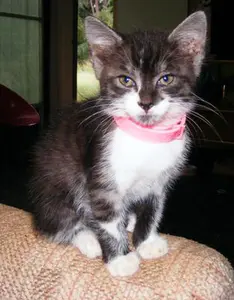
How to sell a rare cat?
by Anonymous
If I believe I have a rare cat, do I need to get a genealogy test to sell them?
Editor's note: I posted this on behalf of someone who asked this question via the contact form. Since I've had many similar such questions, I thought I'd post my answer for all to see.*
Depending on how you interpret it, this could be a question about selling a single cat, or it could be about breeding (based on the use of the word "them").
I assume by "rare" we're talking about a domestic cat you suspect of being a certain breed, but for that I don't think a genealogy test is going to be all that revealing.
Either way, only pedigreed cats command a premium price, and a genealogy test does not equal a pedigree. And that brings me to the concept of pedigree, pure bred, and how breeders work.
Only a small percentage of domestic cats are pure bred, meaning they're of a specific breed. Breeds are defined differently by each registry. For example, the Cat Fancier's Association has a different list of cat breeds from TICA. Each registry will have its own parameters for each breed, and the specifics of those will vary.
An even smaller percentage of cats are what is known as pedigreed. A pedigreed cat is a pure bred that's lineage is verified and recorded in a cat breed registry. When you buy a pedigreed cat from a breeder, you get "papers" that act as proof that the cat is of a certain breed and lineage. Therefore, only a small percentage of cats are ever sold as such and command a premium.
When someone says they picked up a Maine Coon cat at the pound, it's highly unlikely the cat they have is a pure bred Maine Coon. Maine Coons don't normally stroll into cat shelters. It's more likely a cat that looks like a Maine Coon, or a Maine Coon (or similar) mix. It's an almost zero chance that it's a pedigreed Maine Coon.
Non-pedigreed cats are not verified to be of a certain breed (even though they may be or may have some of that breed in their genes, like our Maine
As for cat breeders (in case anyone is thinking about becoming a breeder), breeders spend a lot of money, time, and effort breeding and raising pedigreed cats, and traveling to show their cats at cat shows.
There is a dark side to breeding as well, including what are called backyard breeders, and of course puppy and kitten mills which are more likely to make it on the news. But legitimate breeders don't do it for profit and it may cost them more than they recoup. To break into breeding, they usually spend some years learning the ropes from other breeders, and when they're ready, they breed pedigreed cats starting with cats from those other breeders. There's no other way to preserve the lineage and the integrity of the breeding process, and make sure the new breeders are doing things the right way.
I've never heard of anyone using a genealogy test to determine the price of cat, and people who pay premium prices for pure bred cats with a pedigree usually know what they're looking for and will go to a legitimate breeder. Without papers from a breeder, you've got no leverage.
*To those who would ask, I am not against legit breeding as I believe it has an upside in terms of education and data gathering, especially for genetic and disease tracking, but I am not a fan of people selling cats outside of that ecosystem as it lacks traceability. Any answers I post on this site, as always, are my opinion, and are for educational, entertainment, and discussion purposes only. I don't claim to be an expert, just a fellow cat lover, and I encourage everyone to do their own research. Questions like these, and the answers we get from the community, are valuable for a well-rounded picture of what's going on in the cat world and what people are actually thinking and doing with respect to cats. I encourage open discussion and debate.
Join in and write your own page! It's easy to do. How? Simply click here to return to Cat Questions.
Like us on Facebook
Latest Meows
-
How to sell a rare cat?
If I believe I have a rare cat, do I need to get a genealogy test to sell them? Editor's note: I posted this on behalf of someone who asked this question -
Should I be adopting a kitten if I already have an 8 year old cat?
My cat is a rescue but has settled in quite easily, I've had him since October 2024 and is very cuddly and is only aggressive when he doesn't like what -
Hector from Cabarlah
 My loved, and beloved dear little Hector was born on 23rd February 2018 and I became his custodian on Easter Sunday, 1st April 2018 when he was 37 days