Why Do Cats Purr?
Why do cats purr? Excellent question!
That question has been asked by experts and lay persons alike for quite some time.
Not all species of cat purr, but all domestic kittens are born with purring ability.
Like their colors and shapes, not all cat purrs are the same, even within the same species.
Although the core purr sounds all fall within a certain frequency range, even across species, the volume, type, and harmonic (additional, complementary), cat sounds vary. They can range from a low rumbling sound, all the way up to a high pitched trill, depending upon the physical attributes of the cat and its mood.
Cats typically purr when they are content, and so we normally associate the act of purring with a happy cat. For example, some cats will begin purring if you just direct a glance their way for long enough. Others take a little bit of scratching or talking to, and then there it is.
It should be noted, however, that cats also purr when they are distressed, or in pain. Female cats will purr while giving birth, presumably to act as a beacon for the blind and deaf kittens that she is bringing into the world. Perhaps it is to comfort herself as well.
And that may be one part of the answer to the question, why do cats purr? It is soothing, and makes the cat, and others around her, feel good.
Over the last few years, some fairly extensive research has been compiled on the purring question as scientists ask why do cats purr? The results have been interesting as this article in Scientific American reveals.
Using data collected about the various purring cat species, and comparing that to studies done on the healing qualities of sound vibration, a connection has been made.
Further comparing cats to dogs (who obviously do not purr), with respect to complications from surgery, healing time, and other health items, researchers may have found the answer to why cats purr.
It would appear that purring may be some sort of built-in survival mechanism. Purring may be a way to improve muscle tone without exercise, reduce pain, and repair fractures!
As the Scientific American article points out, cats are very resilient:
"The durability of the cat has facilitated the notion that cats have "nine lives" and a common veterinary legend holds that cats are able to reassemble their bones when placed in the same room with all their parts. Purring may provide a basis for this feline mythology."
It seems that sound vibrations, in the same frequency range (including harmonic vibrations) as a cat purr, can actually act as a healing aid, reduce pain, and promote tissue growth.
That's right - everything from increased bone density, to improved muscle tone, to tendon repair, to therapeutic pain relief is aided by low frequency vibrations. Vibrations, by the way, in the range of the cat purr.
So, why exactly do cats purr? Well, on the surface it may be to express emotion, but literally the underlying reason may be that it is essential for your cat's health!
So now that you know it's good for your cat and for you, go make your cat purr!
More cat questions.
Like us on Facebook
Latest Meows
-
Moose from Flint
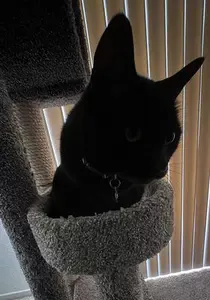 Moose is the last of my pets who were named after the Bullwinkle show. Rocky recently went to rainbow Bridge. Before him I had Boris and Natasha. I have
 -
November 29th, 1973 by SpectraColor
I composed and sing the original music, and the animated cats are derived from my three actual cats; Diddles, Charcoal and Ashley! Watch on YouTube -
Have you ever seen someone so hungry?
 This is Tootie (Forest J. Cat). She loves furry little boxes, birds, catnip, me, sun-bathing, and most of all... FOOOOD. I literally had to trap her

Comments: What do you think?
Have your say about what you just read. Leave me a comment in the box below.