Domestic Cat Fact Sheet
A domestic cat fact sheet for you to chew on, so to speak. We discuss hybrids, pedigrees, cat fleas, scenting and marking, and more.
The Odd Domestic Cat Fact
- If a cat gets oil or excessive amounts of dirt on its fur, a so called bran bath may be used to remove the dirt and oil from the fur.
- Domestic cats are said to be descended from the African wild cat. These cats are hard to distinguish from the domestic tabby, and weight about 9 to 11 lbs.
- A hybrid cat is actually a domestic cat crossed with a wild cat. There are various hybrid cat breeds, each of which involves different crosses. A common example is the Bengal cat, which is a domestic crossed with an Asian leopard cat.
- According to the Cat Fancier's Association, less than 1% of all domestic cats in the world are pedigreed cats. So, your cat may resemble a particular breed, but if you haven't got the papers to prove it, who knows?!
- If you plan to show your cat, then you'll not only need papers for the pedigree, but also certificates of vaccination in order to participate.
- Cat fleas will sometimes jump from cats to humans, but they prefer cats. If possible, stick to non-toxic and natural flea killer.
- Polydactyl, or "many-toed" cats, have more than the usual number of toes. The polydactyl gene is dominant, and therefore shows if it is present. The polydactyl feature is common in the Maine Coon cat.
Selective breeding has reduced or eliminated this trait from some of the gene pools of certain pedigreed cat lines. There are some people who would like to preserve it, however, such as certain Maine Coon Poly enthusiasts.
Diet, Cat Food, and Teeth
- The tooth fairy visits your cat at about 5 months old.
- Feeding your cat dry food may help to keep her teeth healthy. Some cat health experts dispute this. For example... Veterinarian Lisa Pierson, who advocates a species appropriate diet for carnivorous cats, and homemade cat food recipes disagrees: "Long-standing claims that cats have less dental disease when they are fed dry food versus canned food are grossly overrated, inaccurate, and are not supported by recent studies." According to Iams, feeding their food with "dental technology" does this: "In cats, feeding the diets with our dental technology reduced tartar buildup as much as 40% compared with cats fed the control diets."
- House cats often eat grass. Grass adds folic acid to your cat's diet, and may also act as roughage and help her to bring up fur balls.
- Average adult female domestic cats need to consume about 200 to 250 calories per day, and males about 250 to 300.
- The National Research Council of the National Academy of Sciences estimates that obesity will occur in 25 percent of dogs and cats. My cat Teddie was overweight, but increasing her activity level with regular play sessions worked to bring her weight back in line... better than kitty cat Weight Watchers I'm sure.
- Adult cats have 30 teeth.
- Cat food creators have tried to make the most premium of premium cat foods. This "mouse flavored" cat food has so far failed all taste tests. Either you can't fool mother nature, or the testers are too finicky.
Territory, Scent, and the Nose Knows
- Cats use their powerful sense of smell to determine the identity of other living things, and to determine who has been in an area before.
- Cats will deposit scent markings in order to define territory, and help them feel more secure.
- Scratching on trees and other objects is a way of sharpening the claws, but it also serves to deposit a marking scent via the scent glands between the toes.
- Domestic cats will spray inside the house if they feel threatened. Insecure cats will spread their scent around this way in order to feel more secure and in command.
- Your cat may feel threatened, and compelled to spray, if strange scents are brought into the house on shoes, clothing, or personal items, or if a cat outside is badgering them.
- Do not punish your cat for spraying, as this will make her feel more insecure. Instead, try determining the source of the problem and coming up with a solution.
- Feliway is a synthetic version (no, it's not extracted or made from cats) of the domestic cat cheek pheromone. Spraying it around the house may relieve tension and make cats feel less aggressive as it simulates the result of cheek rubbing.
Like us on Facebook
Latest Meows
-
Moose from Flint
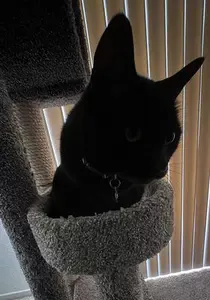 Moose is the last of my pets who were named after the Bullwinkle show. Rocky recently went to rainbow Bridge. Before him I had Boris and Natasha. I have
 -
November 29th, 1973 by SpectraColor
I composed and sing the original music, and the animated cats are derived from my three actual cats; Diddles, Charcoal and Ashley! Watch on YouTube -
Have you ever seen someone so hungry?
 This is Tootie (Forest J. Cat). She loves furry little boxes, birds, catnip, me, sun-bathing, and most of all... FOOOOD. I literally had to trap her
Comments: What do you think?
Have your say about what you just read. Leave me a comment in the box below.