Cat Repellent for Furniture
An effective cat repellent for furniture items, whether used as a scratching deterrent or to keep your cat off the furniture entirely, is double sided tape. I'll explain how to use it in a moment, but first...
About Scratching Behavior
Scratching is an instinctive feline behavior.
You can't stop your cat from scratching, and in fact, you shouldn't try as it can lead to behavioral problems. The key is to encourage "appropriate" scratching and provide the right circumstances for this.
When your cat scratches, several things are happening, including the sharpening of claws and the depositing of scent markings. There is also some stretching and a bit of an exercise workout.
This behavior makes your cat feel more secure and is a bit of a stress reliever as well. This behavior is so ingrained that even declawed cats will still scratch.
You should always give your cat an alternative location where she can carry out instinctive scratching behavior and feel secure. A cat tree, scratching post, or scratching board works well for this. If you rub some catnip on it (or catnip oil) it's even better.
About 80 percent of cats react to catnip and will normally be attracted to the plant. It's a genetic trait, so your cat will either respond to catnip or she won't. Those who do usually go crazy over it and have a euphoric action to the aromatic oil that lasts several minutes.
If you grow a catnip plant inside a bird cage, your cat can rub on it and nibble on the leaves without destroying the plant. Place this plant in an area that you want your cat to frequent (with a scratching post or board or cat tree nearby).
Once you've provided an alternative permitted scratching area (two areas would be better), then it's time to look at what you can use as a cat repellent for furniture and other household items.
Physical Deterrents
Sticky Paws
Cats don't like the feel of certain surfaces and they especially don't like the sticky feel of double-sided tape on their paws. Sticky Paws for Furniture adhesive strips stop cats from tearing up your furniture by providing a surface that cats don't like to scratch.
Unlike most double-sided tape, the strips are transparent so they're more aesthetically pleasing. You can easily stick them on fabric and they can be easily removed.
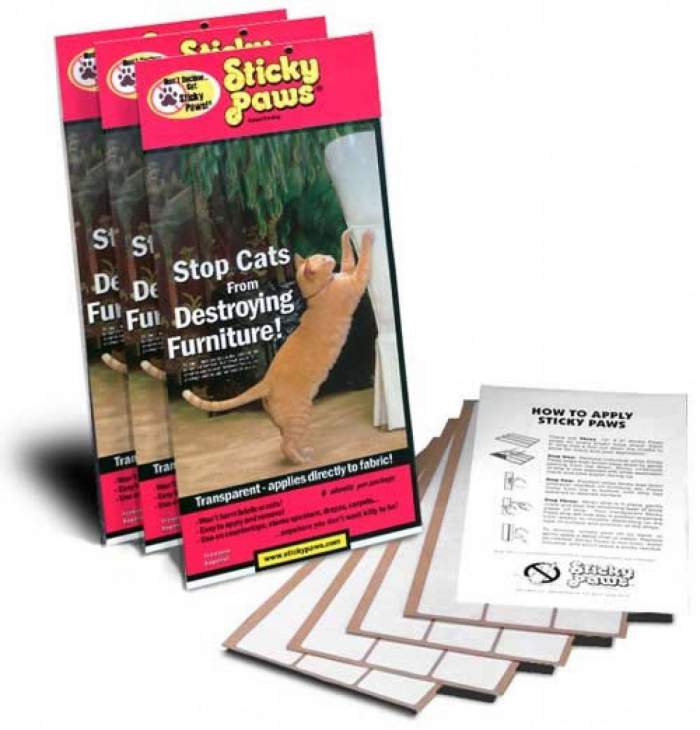
They can be used on counter tops, sofas, chairs, speaker grills, screen doors, curtains, furniture, carpets and more. Sticky Paws come in 2" X 12" regular size, or an extra large 9" X 12" size for larger areas. They can also be used for inappropriate elimination problems.
Since this product is using adhesive, it's possible that it may damage certain surfaces, including lifting some laminates. It may also possibly lift paint or wallpaper, or damage vinyl, leather, or wood finishes.
Always test a small inconspicuous area before applying it. Sticky Paws won't work on surfaces treated with non-stick and/or stain-repellent products, such as Scotchgard.
You can use them (or standard double-sided tape), however, on cardboard sheets, making it easy to move them from one area to another if needed. This works for counter tops, stair wells, window sills, carpets, and areas where your cat has urinated or defecated inappropriately.
You can buy them at Amazon.
X-mat
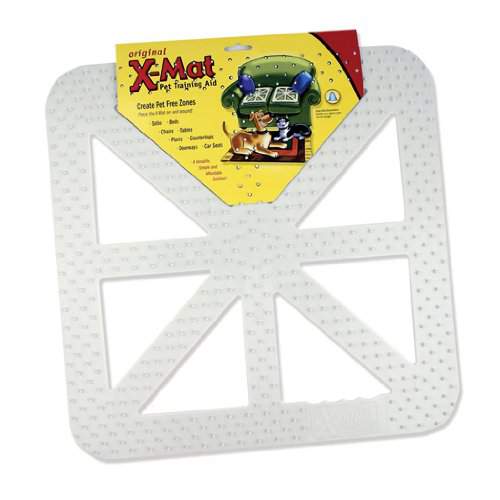
The X-mat uses an uncomfortable, bumpy surface to keep your cat off the furniture. It can be used on countertops, tables, dressers, sofas, chairs or window sills and ledges.
You can buy it at Amazon.
Keeping cats away from wires
Some cats love to chew on wires. This can cause both problems with your equipment, and deliver dangerous shocks to your cat.
Loose wires, especially dangling ones can be very tempting to play with as well. Covering your wiring and cables with split convoluted tubing can help. It also makes your wiring more manageable and neat.
Wire Loom split convoluted tubing (often called split wire loom) comes in varying lengths and widths so you can group your wires together. In case your wires are exposed, it also comes in various colors to better match your decor.
You can enhance the effectiveness of this by coating the tubing with some of the sprays that have a nasty taste (such Bitter Apple Spray or Bitter Yuck). Although a bit of an awkward solution, you could wrap Sticky Paws or double sided tape around it instead, and make a cut where the split in the tubing is.
You can usually get a good price on Split Wire Loom Tubing at Amazon.
Scents, Tastes, and Plants
Cats often like catnip, but there are some plants and scents, as well as tastes that cats dislike. You can use this as a cat repellent for furniture, counter tops, and so on and control where your cat goes in the house or garden.
Grow any of the following plants and place them (or the clippings) in areas you don't want your cat to go: Coleus canina, lavender, pennyroyal, rosemary, or rue. Cats also don't like the smell of citrus, so you can use lemon, lime, and orange to drive cats away from certain areas as well.
Here is some more detail on these and other natural cat repellent methods for indoor and outdoor use, including some commercial products.
Bitter Yuck by NaturVet
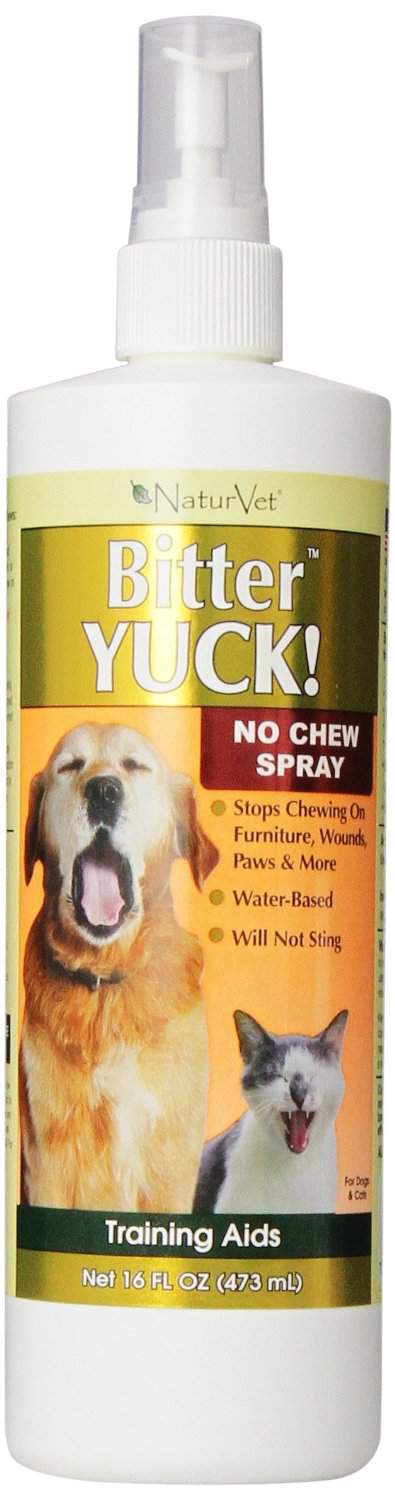
Fern from Life on the Balcony recommends Bitter Yuck as a way to keep cats from eating plants. Bitter Yuck uses rosemary to keep cats away. You can spray it on various areas of the house including cords to stop chewing.
You can get it at Amazon.


Granicks' Bitter Apple Spray
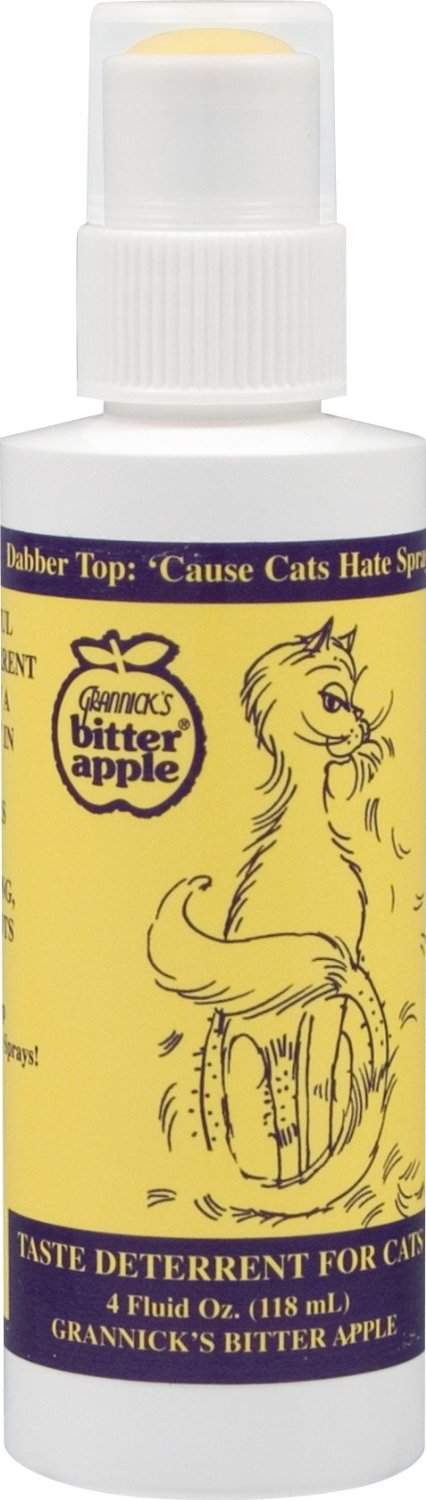
Bitter Apple Spray is a similar idea to Bitter Yuck, and you can spray these products on dried or fake flowers, or on plants or planters. Place the treated items on or near tables, chairs, sofas or other furniture to keep your cat away.
Boundary Indoor/Outdoor Dog & cat Spray Repellent
Boundary is an indoor/outdoor repellent that has an odor that is unpleasant to dogs and cats, but not to humans. It's recommended for keeping pets off furniture, carpet, trees, and shrubs. Spray it on the area and the pet stays away. It's also recommended for use in carports or garages for repelling stray cats.
Electronic Cat Repellent for Furniture Areas
You can buy Sofa Scram at Amazon.
There are a number of electronic indoor and outdoor deterrent products. The outdoor ones generally use an ultrasonic frequency and/or water.
For indoor use, some use an ultrasonic frequency, others an audible alarm, and others use a spray repellent (such as compressed air), or a combination. The ultrasonic frequency or even the audible alarm may not be effective on a cat who is comfortable inside the house.
Indoor repellent products include the Tattle Tale Pet Vibration Alarm, SSSCat Spray Cat Deterrent, and CatScram.
Vendors of CatScram warn that cats that are hard of hearing, kittens, and senior cats may not respond to the product. Also on that list are particular breeds, such as some exotic breeds and Maine coon cats, although I don't know why.
Another type of electronic deterrent that may be effective on countertops, tables, and other furniture is the ScatMat. This product delivers an electric shock (similar to electric fence products) to deter the cat.
Alternatives to Repellents
There are non-repellent solutions for preventing damage to furniture.
While not a cat repellent, nail caps (such as Soft Claws for Cats) can be used to prevent damage to furniture and other objects in the home, since declawing is not an option. Also, Feliway can be used in both a spray form and as a plug-in diffuser to reduce tension, help with litter box problems, and aggression. This may reduce the need to scratch furniture, jump on counters, and so on.
Related Topics
Here are the basics of cat deterrent and repellent
These are some natural cat repellents
As an alternative to the couch, get a cat scratching post
Like us on Facebook
Latest Meows
-
Abandoned elderly cats abandoned again
There is a rat infestation in the general area the cats have been feeding in for the past decade so can’t feed them there anymore. Suggestions? -
Love "Bug" from New Mexico
 My Mom adopted me from the shelter when I was 2 years old. She thought I was the sweetest little thing she ever saw. She named me Lovebug but calls me
 -
Bald spot and white bump on cat's chin?
 My cat has woke up this morning with a hairless area on his chin and a white bump. He's sitting getting cuddles and ate breakfast but he seems sad.
Comments: What do you think?
Have your say about what you just read. Leave me a comment in the box below.